Categories
Comment

Ori and the Will of the Wisps

Ori and the Will of the Wisps’ bosses are tough. So tough, I’d gotten so good at fighting friendly ‘Guardian of the Marsh’ turned corrupted murder-toad, Kwolok, and died so many times, that I earned the associated achievement for speed-running his encounter the first time I licked his froggy face. 

That’s not to say that Wisps is frustrating. On the contrary, it’s a ‘if you die it’s your fault game’. I was to blame for every death.

Like each Metroidvania before it, you begin Wisps controlling a laughably underpowered character and end it feeling like a god. At the outset, Ori can scarcely muster a double jump. Ten hours later, you’ll be chaining triple jumps, wall grabs, grapples, bashes, dashes, burrowing, swimming, gliding and 360-degree ‘launches’ without touching the ground and wondering how you ever coped without them.

Ori can use Launch and Bash to pause in mid-air and shoot in a straight line in any direction

Executing all of this feels incredible. Ori is lithe and nimble and flows across the screen in graceful arcs, but, can also turn on a dime; pausing in mid-air and launching in a straight line in any direction. It’s exceptionally responsive and immensely satisfying and, while the skills above may seem a lot to learn, Moon Studios award them a perfect pace, so you never feel overwhelmed.

So many shards

In addition to permanent abilities, Ori can collect Spirit Shards; upgrades you can turn on and off at any time. These range from the scarcely noticeable to the game-changing. The Lifeforce Shard, for example, merely raises damage dealt by 10% when above half-life. In contrast, the Triple Jump Shard, adds, you guessed it, a third jump to Ori’s repertoire, allowing you to reach inaccessible areas far earlier than had you chosen not to utilise it. 

Struggling with a platforming section? Switch on the Sticky Shard to stick to and climb on walls. Troubled by a tricky fight? Turn on the Life Harvest Shard to seize more life orbs from your vanquished foes. It’s a fascinating system, allowing you to change the difficulty and mechanics available to you in both traversal and combat at any time.  

Splinter and Quickshot transform a single arrow into shower of death

My favourite Shards are Splinter and Quickshot. Both augment Ori’s new ‘Spirit Arc’ ability, a ranged attack allowing Ori to fire a single arrow in any direction. Splinter and Quickshot alter it by splitting the arrow into multiple arrows and allowing you to fire 25% faster respectively. These upgrades feel like collecting a power-up in a ‘shoot ’em up’ like Darius or R-Type – widening and accelerating your shots – and dramatically alter the character of combat.

Wellspring Glades and the Darunia-esque Grom the Builder

You can upgrade Shards by trading Spirit Light (Wisp’s lowest level collectable) in the game’s central hub, Wellspring Glades. A pleasant autumnal haven you can develop by trading Gorlek Ore (another collectable) with the ‘Goron-Esque’ Grom the Builder. I relish the chance to build-out towns in action games – Assassin’s Creed: Brotherhood’s Monteriggioni, for example, is excellent – and Moon Studios put the mechanic to good use with each upgrade granting access to more collectables and shortcuts.

Without spoiling anything, the ending of Wisps is definitive. While there is always some wriggle room for the series to return, it appears Moon Studios will not lead it. They’re reportedly moving on to an Action RPG and, based on the polish manifest in Wisps, I cannot wait to see what they produce.
Categories
Reviews

Resident Evil 7: Biohazard

Remember to duck

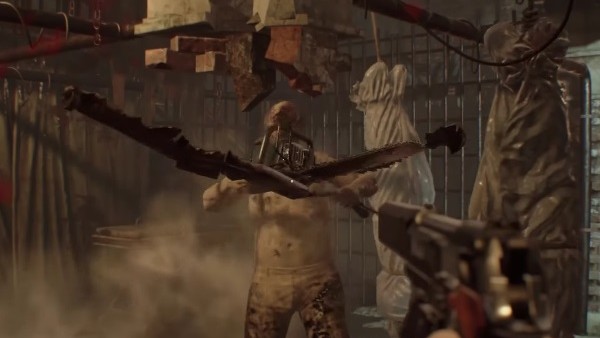
There’s a point early in Resident Evil 7: Biohazard where the game’s initial antagonist, Jack’ Daddy’ Baker, rips through a chicken wire fence to grab one of the most unusual weapons I’ve seen embedded in a blood-splattered hospital bed – chainsaw scissors.

This moment, and the ensuing boss fight, perfectly encapsulates everything good and bad about the game.

Jack terrified me, and the way he wielded the chainsaw scissors like Cal Kestis wields a double-bladed lightsaber as I ducked and dodged and used body bag wrapped corpses hooked on the ceiling of his basement morgue for defence, only amplified this.

To get through the first half of the game, I had to follow Kirk Hamilton’s tips in ‘How To Enjoy Resident Evil 7 If You’re A Big Scaredy Cat’. Yes, I played at midday, with the sound low and my ‘happy’ playlist on in the background.

However, this feeling of terror diminished as I had to restart the boss fight ten times. It’s not that the controls are bad, the first-person aiming is tight, and a tap of the back and circle buttons will spin you 180 degrees allowing you to make a quick escape from enemies, but the movement speed is painfully slow.

This may have been a deliberate choice by Capcom to heighten tension in enemy encounters and an ode to the glacial tank controls of Resident Evils gone by. But in the enclosed spaces of the Bakers’ Louisiana ‘Processing Centre’, it serves to frustrate rather than engender fear.

Further, the farther the plot gets from Jack’s basement and his ‘The Texas Chain Saw Massacre’ family of cannibals and into the broader conspiracy of why you can thrust your chainsaw through his skull, the more it falls apart.

Nevertheless, driving your chainsaw through Jack’s head and seeing blood and sinew explode out in all directions before he gets up a resumes his Darth Maul impression is satisfying, and this holds true for the rest of the game’s combat.

Taking out the Molded (Resident Evil 7’s version of brain-hungry zombies) is consistently engaging, and I always enjoyed using the new weapons that the game dolls out throughout its ten-hour runtime.

My particular favourite is the Remote Bomb, obtained in a wrecked tanker ship towards the end of the game that you can plant ahead of a crowd of shuffling Molded and detonate at will, severing limbs and halting their progress in the process.

Though, by the time you reach the Wrecked Ship in the second half of the story, the game hands out ammunition readily and defeating the Moulded, at least on normal difficulty, becomes relatively easy. This is in stark contrast to Jack’s house where you have to conserve every bullet just in case he’s about to come crashing through the wall.

Despite the disparity between the first and second halves of the game, I thoroughly enjoyed my time with Resident Evil 7 and am looking forward to seeing where Capcom take the series next.

Oh, and remember to duck under those chainsaw scissors – you’ll get a trophy – and feel like a Jedi.